

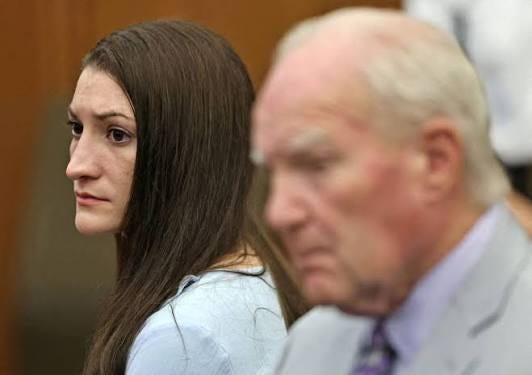
After the mistrial in the Lindsay Clancy case, I saw people online suggesting that perhaps artificial intelligence should eventually replace human juries. Clancy admitted to killing her three children, but the central question at trial was whether she was criminally responsible because of her mental state at the time. After nearly forty hours of deliberation, eleven jurors were reportedly prepared to find her not guilty by reason of insanity. One was not.
For some people, this was another example of the problem with leaving something as important as justice to emotional, inconsistent, unpredictable human beings. Presumably, an AI jury wouldn’t cry during testimony, identify with the defendant, hate one of the lawyers, carry a political opinion into deliberations, or stubbornly refuse to change its mind. Give it the evidence. Give it the law. Let it calculate the verdict.
Nothing follows orders quite like a robot because a robot doesn’t have to wrestle with an order before obeying it. That is precisely what makes the robot useful, and it is also precisely what makes the robot terrifying.
At almost the same moment on our timeline, Anthropic, one of the companies building the most advanced artificial intelligence in the world, has been drawing a line around manufacturing fully autonomous weapons for the US military. The company isn’t opposed to military use of AI, or even autonomous weapons in principle. Its concern is that today’s AI systems aren’t reliable enough to remove human beings completely from decisions about selecting and engaging targets. When a machine is deciding who lives and who dies, Anthropic still wants a human somewhere in the loop. Ironically, we are beginning to wonder whether machines should judge human beings because humans are too human, while some of the people building the machines are warning us that machines shouldn’t be allowed to kill human beings because machines aren’t human enough. Mad world right?
Neverthelesss, humans have long fantasized about a world where we cohabitate with robots, in one form or another. We are fascinated by something like us that can do what we do without all the annoying complications that come with being human. Something that doesn’t get tired, distracted, afraid, offended, depressed, hungry, horny, angry, traumatized, or bored. Something that doesn’t need a vacation, call in sick, develop a conscience, or have an existential crisis in the middle of an assignment.
We tend to talk about robots as though their great appeal is intelligence, or efficiency, but I wonder if that is really it. Maybe the great appeal of the robot isn’t those things at all. Maybe it’s obedience.
The military makes it particularly obvious that absolute obedience is their highest value. Armies have always depended upon obedience, and the problem with human soldiers is that somewhere between receiving an order and carrying it out there is still a human being. Human beings hesitate. They get scared. They misunderstand. They look through the sights and sometimes see another human being instead of a target. They can decide that an order is immoral. They can refuse to pull the trigger. They can change their minds.
Nothing follows orders quite like a robot because a robot doesn’t have to wrestle with an order before obeying it. That is precisely what makes the robot useful, and it is also precisely what makes the robot terrifying. Some of the moments we remember as the highest expressions of human morality happened because somebody did what a machine would never do. They were given the command, understood exactly what was expected of them, and said no.
“The Sabbath was made for man, and not man for the Sabbath” (Mark 2:27, NKJV). That sentence has implications far beyond Sabbath observance. The system exists for the human being. The human being does not exist for the system. I wonder how much religious cruelty has occurred because we reversed those two sentences and convinced ourselves that obedience to the system was the same thing as faithfulness to God.
Robots make visible something we have wanted from human beings for a long time. We admire people who are disciplined, consistent, rational, predictable. We build institutions around policies and procedures designed to produce the same results regardless of who happens to be making the decision. We are suspicious of people who hesitate, make exceptions, change their minds, or allow emotion to complicate what seems obvious. There are good reasons for some of that. Consistency can protect us from favoritism and prejudice, and rules can restrain the whims of people with power. But there is a point where consistency becomes something else, where we begin to imagine that the ideal human being is the one who has eliminated the messiness of judgment altogether. The person who doesn’t have to wrestle with what to do because the answer has already been provided.
Religion can be especially good at producing that kind of certainty. Fundamentalism, although certainly not limited to religion, offers the comfort of becoming something like an algorithm. If this, then that. Here is the rule. Here is the text. Here is the correct interpretation. Here is the category this person belongs in, and here is what must therefore be done with that person. There is something enormously comforting about that kind of certainty because discernment is exhausting. Discernment requires us to encounter circumstances the rule didn’t anticipate, people who don’t fit our categories, competing goods, conflicting responsibilities, and situations where every available choice leaves something broken. An algorithm doesn’t wrestle with any of that. It simply applies the rule.
Which is strange, because the Jesus Christians claim to follow was maddeningly difficult to turn into an algorithm. People repeatedly brought Jesus situations where the religious machinery appeared to have already produced an answer. The law said this, tradition said that, this person belonged in this category, therefore this consequence should follow. Jesus kept screwing up the equation. He healed when he wasn’t supposed to heal, touched people he wasn’t supposed to touch, ate with people he wasn’t supposed to eat with, and allowed his disciples to pick grain when they weren’t supposed to pick grain. When religious leaders complained, Jesus responded, “The Sabbath was made for man, and not man for the Sabbath” (Mark 2:27, NKJV). That sentence has implications far beyond Sabbath observance. The system exists for the human being. The human being does not exist for the system. I wonder how much religious cruelty has occurred because we reversed those two sentences and convinced ourselves that obedience to the system was the same thing as faithfulness to God.
But our desire for a robotic universe goes even deeper than fundamentalism. It shows up in the questions we ask about God, especially the problem of evil. If God is good and God is powerful, why does God allow horrible things to happen? It is not a question Christians should dismiss or solve too quickly. Children get cancer. People murder their families. Human beings abuse, rape, torture, exploit, and kill one another. Any theology that can look at those realities and immediately produce a neat explanation probably hasn’t understood the question.
But there is something interesting buried inside some of our proposed solutions. Why didn’t God stop him? Why didn’t God make her choose differently? Why create human beings capable of doing something like this in the first place? Why doesn’t God intervene at the moment when human freedom is about to become destructive? Theologically, we call these questions of theodicy.
Maybe God could have created a world populated by creatures programmed always to choose the good, but I’m not sure those creatures could love God, or one another, in the way we mean when we use the word love.
I understand those questions because I ask them too. But follow them far enough and eventually we begin asking why God didn’t make better robots. We want human beings to possess meaningful freedom, but we also want God to override that freedom whenever it is about to produce consequences horrible enough to offend us. We want freedom with certain choices removed from the menu. We want the ability to choose, provided God prevents us from choosing the worst things. The problem is that once God guarantees the outcome, it becomes increasingly difficult to call the process freedom. And Christianity has traditionally insisted that there is something at stake in that freedom beyond our ability to do evil. The same freedom that makes hatred possible makes love possible. Love that cannot be withheld isn’t love in any meaningful sense. Courage means something because cowardice was possible. Faithfulness means something because betrayal was possible. Forgiveness means something because condemnation was available. Maybe God could have created a world populated by creatures programmed always to choose the good, but I’m not sure those creatures could love God, or one another, in the way we mean when we use the word love.
And yet there is an even stranger side to the problem of theodicy. We don’t only wish sometimes that God had made us more robotic. We often wish God were more robotic too. We want God to be predictable enough that the universe makes sense to us. Good people should receive this. Bad people should receive that. Prayer plus faith should produce healing. Obedience should produce blessing. Suffering should have an identifiable purpose. If God is good, then God must act in the ways we have determined goodness requires. Give us the variables and we will tell you what the divine output should be. Much of the argument between believers and unbelievers about God can begin to sound like competing attempts to solve an equation, with both sides assuming that if God exists, God should behave consistently enough for us to reverse-engineer the algorithm.
The Bible is surprisingly resistant to giving us that kind of God. Job’s friends certainly wanted one. They had a theological system that explained suffering perfectly well until an actual suffering human being sat down in front of them and refused to fit it. Job must have sinned because righteous people don’t suffer like this. The equation demanded it. What they couldn’t tolerate was the possibility that reality might be more complicated than their theology. Jesus creates the same problem everywhere he goes. People know who God blesses, who God condemns, who is clean, who is unclean, who is righteous, who is sinful, and Jesus keeps crossing the lines. The God revealed in Jesus is faithful, but faithfulness isn’t the same thing as predictability. Love isn’t an algorithm.
The gospel is not the story of God rescuing us from being human. It is the story of God showing us what being human was supposed to look like in the first place.
That may be what bothers me about our growing preference for AI and robots. I’m not particularly afraid that robots are going to become human. I’m more interested in why human beings are so eager to become robots.
I think the Christian faith offers a compelling answer to all of this. The gospel is not the story of God rescuing us from being human. It is the story of God showing us what being human was supposed to look like in the first place.
One of the earliest Christian theologians, Irenaeus, understood salvation in terms of what he called recapitulation. In Christ, God takes up the human story and lives it again, restoring what had become distorted along the way. Jesus doesn’t come to make us something other than human. He comes as the fully human one, to lead humanity toward what it was created to become. Irenaeus famously wrote that “the glory of God is a living man,” a line often paraphrased as “the glory of God is a human being fully alive.” We tend to hear that through the language of modern self-actualization, as though God is most glorified when I am living my best life. Irenaeus meant something much deeper. The glory of God is revealed in humanity finally becoming what God intended humanity to be.
That makes the Incarnation even more remarkable to me. Christianity says that when God set out to save humanity, God became human. Jesus got hungry. He became tired. He wept. He was angry. He loved particular people. He grieved the death of his friend. He was moved with compassion. He suffered. The answer to everything that had gone wrong with humanity was not to strip humanity away, but to inhabit it completely.
And maybe that is where our fascination with the perfectly rational, perfectly predictable, perfectly obedient creature gets the gospel backward. Salvation isn’t God slowly removing all the troublesome humanity from us until we finally behave. The goal isn’t compliance. It is transformation. Sin doesn’t make us too human. It makes us less than human. And grace doesn’t turn us into something other than human. It restores us to our humanity.
Perhaps that’s why Jesus is such a terrible robot. He is constantly discerning, responding, touching, grieving, forgiving, becoming angry, showing mercy, and encountering the person standing in front of him rather than merely processing the category they belong to. Christians believe this isn’t an unfortunate side effect of the Incarnation. This is what God looks like as a human being. And according to the gospel, it is what we are becoming too.