

I grew up in what is often referred to as a Holiness church. We had a lot of rules to follow. When I was a child, we weren’t allowed to go to movie theaters. We couldn’t go to the beach (so we went to the “coast” instead). Men weren’t allowed to grow our hair long. Women weren’t allowed to cut their hair. Women also had a dress code to follow, and if they did not follow the dress code, they could be kicked out of the church. In fact, I had an aunt who was kicked out of our church for wearing sandals that showed her toes, even though they closed off her heel. She was told that showing the heel was fine, but the toes were just too much!
In the Holiness church, we believed in salvation by grace, the same as Presbyterians. But we also believed that salvation could be lost — that what God gave, sin could take back. We called it backsliding. And we heard about it constantly. So I developed a practice at a young age, without anyone teaching me to, of reviewing my entire day before I slept. Every thought. Every temptation. Every action. Every moment where I might have crossed a line. I would call it out to God and repent for it. In case the rapture took place overnight and I got left behind, or if I died, I wanted to make sure I went to heaven.
I was really trying hard to stay saved. And it turns out I was terrible at it. I used to tell people “my church preached backsliding and I practiced it!” The harder I tried, the more I felt the pull of everything I was tempted by. Eventually this led to a lot of anxiety and depression. The dread of sin became a dread of life. And church — the place where I should feel the closest to God — became the hardest place to be, because I didn’t feel like I belonged there.
What I was experiencing has a name. Theologians and clinicians both use it: religious scrupulosity. It is the spiritual disorder that results when the conscience is trained to find sin everywhere and grace nowhere. When the management of the old self becomes the whole of the religious life. When you are so focused on what you might lose that you cannot receive what you have already been given.
This is not a phenomenon of the modern Holiness movement. It is a struggle as old as time. In his book The Holiness of God, R.C. Sproul describes the religious scrupulosity of Martin Luther, the father of the Reformation. He describes him as “a monk devoted to a rigorous kind of austerity. Luther set out to be the perfect monk. He fasted days and indulged in severe forms of self-flagellation. He went beyond the rules of the monastery in matters of self-denial. His prayer vigils were longer than anyone else’s. He refused the normal allotments of blankets and almost froze to death. He punished his body so severely that he later commented it was in the monk’s cell that did permanent damage to his digestive system.”
I see it today as a chaplain on a daily basis. People living out the final chapters of their lives, still not sure if they are good enough for God.
It is one of the most common referrals I receive. “Dear Chaplain, will you see Ms. Smith? She is a Christian lady reaching the end of life and has expressed that she doesn’t think God loves her and she’s not good enough for heaven. Will you see her?”
That is a paraphrase of an actual referral I received last week. When I visited her in the nursing home, I found an 85-year-old woman who has believed, confessed, repented, been baptized — who loved God her whole life, taught Sunday school, led Bible studies, and tried her best to live a godly life — lying in a hospital bed convinced that God will not be there when she needs God the most. Because she wasn’t good enough. Because there was that one thing, years ago, that she can’t forgive herself for, and she is convinced that even God won’t forgive her. Because the God she was taught to believe in was a God who keeps score, a ledger sheet of good deeds versus bad deeds, and in her heart she knew the balance sheet wasn’t in her favor.
What are we to do then? While believing on the one hand in the grace and forgiveness afforded to us by God through Christ, but on the other hand knowing we don’t always follow his commandments, as Jesus told us to do out of love. Or when our relationship with God feels weak or non-existent. Or when we make poor decisions that turn out to be major life mistakes and we cannot go back in time and undo them. Should we just act like none of that matters? That God’s grace is sufficient? Do we sit down every night and record every sin to make sure that we measure up? Or do we just give in to the sin and say, well, we’re just going to leave it up to God?
Paul asks this question plainly in Romans 6, in response to his teaching on grace in Romans 5: should we continue in sin that grace may increase? He is addressing people who might have drawn the wrong conclusion from the right doctrine. He asks, if grace covers our sin, what does that have to do with how we live day to day? Paul says it has everything to do with how we live. The new life is not a license to remain bound to the old life. The freedom Christ purchased is not permission to go on living as though nothing has changed.
But here is what the Holiness church did with that passage, and what a great deal of Christians have done with it:
When Paul said, “by no means,” we heard: stay clean, or lose what you have. We read, “how can we who died to sin go on living in it?” and we heard: if you are still struggling, you haven’t really died. You haven’t really been saved. Or worse — you were saved, and you lost it, and now you have to get it back.
Because of that, to this day it is very hard for me to tell someone the day I really gave my heart to Jesus. I know that around fifteen or sixteen years old is when I started to really feel that draw to the Lord and really committed my life to following him. But as a child, up to that point, and even after it, every altar call, every opportunity — why not go ahead and get saved? The math seemed straightforward. If you could lose it, you kept renewing it. What I was doing, without knowing the word for it, was practicing scrupulosity — the exhausting, faith-destroying behavior of trying to manage my way into a security that the gospel was already offering me for free.
Paul is not issuing a warning. He is making an announcement. The old self had no choice — it was captive to sin, a slave to sin, bound to it, unable to do anything but live inside its confines. That is what captivity means. But the one who conquered sin, Jesus, is the one in whom you now live. And what is alive in you now is not captive to sin. Sin’s dominion has been broken. Not just weakened. Broken.
This is not a command to Christians to try harder. It is an invitation to live from what is already true about us.
Paul is not saying grace is fragile. He is saying sin has already lost. You are not on probation. You are not one bad week away from forfeiting what Christ purchased. You are free. The question is not whether you might lose your freedom. The question is whether you will live from it — or whether you will go on acting like the chains are still there.
And yet. Most of us know that living in freedom is not as simple as being told to do so. Paul knew it too. Just one chapter later, in Romans 7, he laments: when I want to do what is good, evil lies close at hand. I see in my members another law at war with the law of my mind. Wretched person that I am. Who will rescue me from this body of death?
He is not backsliding. He is being honest about life in the here and now, life in between baptism and resurrection. Between Egypt and the Promised Land. Between Good Friday and Easter. Between what has been declared true about us and what has been fully realized in us. This is where our stories are actually forged — with real people, real emotions, real temptations, real thirst in in-between spaces. It is in these wildernesses where we are tried and tempted, where we find out how much we are in need of the grace of God.
Our lesson from Genesis 21 introduces us to one of those messy in-between places, as Abraham and Sarah wrestled with their new life now that the son of God’s promise, Isaac, had been born. He was the product of God’s covenant with Abraham.
The scene opens in Abraham’s house with Isaac playing with his older brother Ishmael. Ishmael was born out of frustration. He was a child of the flesh, a child born of expediency, when Sarah told Abraham that if he wanted a child he should have one with their Egyptian servant, Hagar.
Sarah saw Ishmael playing with Isaac and could not tolerate it. The son of the slave woman could not share the inheritance with the son of promise. So Abraham, reluctantly but obediently, gave Hagar and Ishmael bread and a skin of water and sent them into the wilderness of Beersheba. An interesting text, by the way, to hear on Father’s Day.
The matter was very distressing to Abraham. That is what the text says. Distressing. He was grieved by it. But he sent them away anyway. He was obedient and trusted God when God said God would take care of Ishmael.
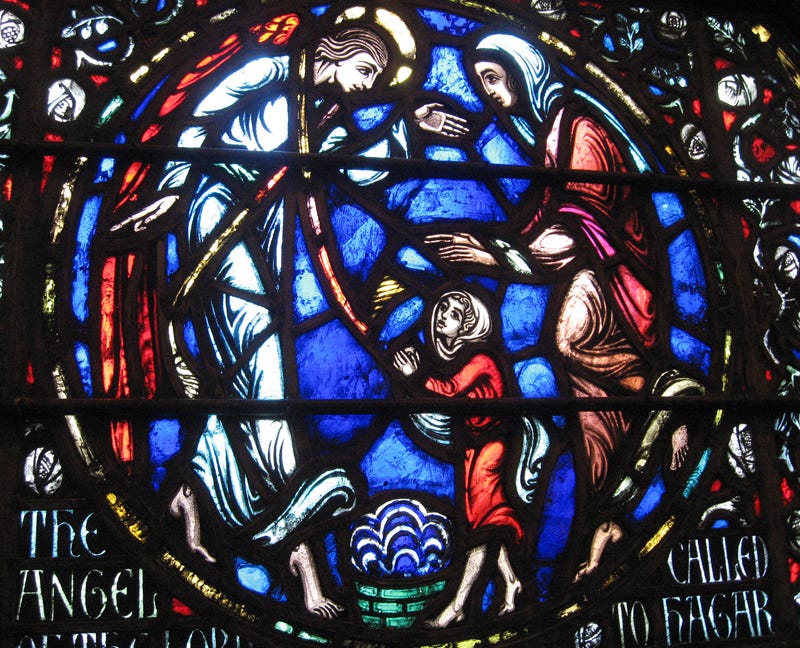
They wandered in the wilderness until the water ran out. Hagar put the boy under a bush because she could not watch him die. She walked away, a bowshot’s distance, and sat down and wept. And God heard the boy crying. What troubles you, Hagar? Do not be afraid. God has heard the voice of the boy where he is. Then God opened her eyes, and she saw a well of water. It was there the whole time. She just could not see it.
This is not the first time God found Hagar in the wilderness. In Genesis 16, when she fled Sarah the first time, God met her there, and she gave God a name: El Roi, the God who sees me.
Interestingly, centuries before the church had the Revised Common Lectionary, Paul referenced the story of Hagar and Ishmael being cast out in his letter to the Galatians. In chapter 4, he reads Hagar and Sarah, Ishmael and Isaac, as an allegory — two women, two sons, two covenants, two ways of coming into relationship with God. Ishmael was born of flesh, of human effort and striving. Isaac was born of promise, of grace, of divine interruption into what seemed impossible.
“Cast out the slave woman and her son!” Paul says to the Galatians. “The child of the flesh cannot inherit alongside the child of promise!”
It is a powerful reading, and it has shaped Christian interpretation for over two thousand years. The old self must go. The new self must take its place.
But then we go back to Genesis 21, and we discover that the son of the flesh did not just disappear. He did not physically die. He never leaves the story. He was still there throughout the Old Testament, he and his descendants, at first hand in hand with the son of promise, then thirsty in the wilderness.
Paul was right. The old self and the new self are real. The life of flesh and the life of promise cannot share the household equally, and our own life experiences confirm it. You cannot live your life out of the old self and expect the new life to flourish. Something has to change. Something has to be sent away.
But notice what God does not ask Abraham to do. Instead of asking Abraham to destroy Ishmael, God asks him to be obedient and to trust Ishmael to God’s care. That is a distinct act of faith in itself. Abraham’s job is not to manage what happens in the wilderness, in the in-between space. His job is to let go and trust the God who sees.
Old Testament scholar Walter Brueggemann concludes from this passage that the fate of natural man and the pilgrimage of the children of promise are two distinct ways in which life can be discerned. Distinct. Not identical, not merged — but both real, both under God’s attention, both within the scope of what God is doing.
This is the tension we actually live in. Not the clean death of the old self that we wish for. Not the elimination of the struggle that we pray for. Instead, we find the coexistence of Ishmael and Isaac — the old life and the new, the flesh and the Spirit, the thirst and the well — running alongside each other in the long journey between baptism and resurrection.
Funny we should be talking about Father Abraham on Father’s Day. Abraham was a complicated father. He had a complicated relationship with his children. Just wait until next week and see what he does. Yet he was called faithful.
My dad died in 2019. It was a big moment in my life, because I was very close to my father. Like Abraham, my dad had me when he was older in age. He did not expect to become a father. I am his only son, his only child, actually. But before he was my dad, he had a life I never knew or saw. At one time, my father was a drug addict and an alcoholic. He had been in and out of treatment programs for most of his adult life. He had even served time in jail. His family tried to help. The church tried to help. Nothing worked. Until one night, before I was born, he had a radical encounter with Jesus and fully surrendered his life to God’s saving power. Miraculously, my dad was instantly delivered from the desire for substances. He testified, his entire life, that even the thought of the taste of alcohol made him sick after he was saved. He never used again. He never felt really tempted by it. He became a good father and a good husband. His deliverance was instantaneous and profound.
But my friend Darren also came to Christ as an addict, and it didn’t happen that way for Darren. Darren spent years in treatment and 12-step programs and accountability. To this day, Darren stays sober by going to meetings, because he knows that’s what he needs. When Darren is honest, he says the thirst might still there. And so he does what is necessary to make sure he is not enslaved to the old life, but that he is giving in to the new.
My father’s story is an Isaac story. The old life ended and did not come back. I am grateful for that, and so was he, every day he lived.
But most of us are living an Ishmael story. The old self does not disappear. It wanders in the wilderness, in the in-between places. It gets thirsty at the edges of the life we are trying to build. And the church has too often told us what to do about that: try harder, manage better, follow more rules, stay clean, avoid the appearance of evil. For most of us, that produces not holiness but scrupulosity — a grinding, exhausting, performance-based worthiness that never quite convinces us, because we know what we are really like on the inside.
So what does obedience look like, if it isn’t the management of the old self? It looks like Abraham. It looks like doing the hard thing God asks — and sometimes God asks hard things, things that cost us, things that grieve us — and then releasing what comes next into God’s hands. Tending to the new life. Trusting God with the wilderness. Not pretending Ishmael isn’t out there, but not being consumed by what Ishmael is doing out there. Trusting that the God who gave you Isaac is the same God who sees Ishmael under the bush.
That is a transferable posture. You can take it into your week. When the old self rises up — when the thirst returns, when the temptation comes, when Paul’s words in Romans 7 feel more true to you than his words in Romans 6 — you do not have to spiral. You do not have to review the day’s sins. You do not have to get saved again and again and again to make sure it took.
You tend to your new life in Christ. You do what obedience asks of you today. And you trust God with the rest.
Barbara Brown Taylor writes that the human longing to be seen — really seen, not for what we perform or produce, but for who we are — is one of the deepest longings we carry.
The woman in the nursing home asked me the question we have all asked in one form or another: “am I good enough for God?”
I could not tell her where she landed on the ledger. I could tell her the ledger was never the point. The better question is, am I loved by God? And the answer to that is always a resounding YES.
This is the word of the Lord. Thanks be to God.