

When I was first asked to preach these last two Sundays, I had no idea what the Lectionary Readings would be. After I read them, I almost changed my mind about preaching from the Lectionary.
(This week’s lesson is Genesis 22:1-14, Year A, Proper 8 (13) in Revised Common Lectionary)
I talked with a colleague this past week about how hard these last two Sundays of the lectionary have been, especially with Father’s Day intersecting with these stories of Father Abraham. He told me that he titled the sermons for last week and this week: “Bad Dad Parts 1 and 2.”
I laughed when he said it, because he’s not wrong. Last week, Abraham sent Hagar and Ishmael into the wilderness with nothing but bread and a skin of water between them. This week, he ties his other son to an altar and lifts a knife over him. If you only had these two stories to go on, you’d be forgiven for thinking Genesis is building a case against Abraham as a parent.
It is a challenging set of stories for the modern reader. We don’t get to skip past those challenges the way earlier generations sometimes did. We live in a culture, rightly, that takes child welfare seriously. We talk about generational trauma: the harm that gets passed down a family line without anyone naming it.
So when we read that God tested Abraham by asking him to do this to his son, we don’t just feel the ancient horror of the request. We feel something closer to home. We wonder: what it does to a child to grow up in a household where obedience to God could look like… this.
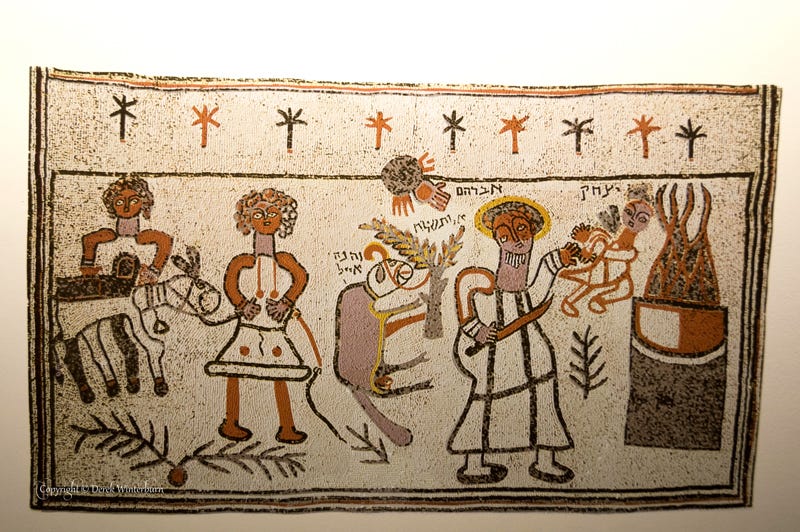
It helps, a little, to know what this request would have sounded like to Abraham himself, standing in his own time rather than ours. Child sacrifice was not the unthinkable thing to the ancient world that it is to us. The nations surrounding Abraham practiced it. It was a known, albeit horrifying, religious act— it was one way ancient people tried to secure the favor of their gods.
What would have shocked Abraham’s first hearers about this story is not that a god might ask for a son. It’s that Abraham’s God STOPS the sacrifice of the child. The scandal of the story, to its original audience, was God’s refusal to take Abraham’s child, not His request.
That doesn’t make our discomfort wrong. It just locates it correctly. We are not the first people to find this story unbearable. We’re not even the first people to find it strange. We’re the first to find it strange for our particular reasons, living where we live, having learned what we’ve learned about what childhood trauma and what does to a person.
But I don’t want to explain the discomfort away this morning. I want us to stay inside it, because that discomfort is where this sermon lives. Not in a tidy resolution where everything Abraham did turns out to be fine because God stopped him in time. But in the harder question underneath it: what do you do with the unbearable thing you’ve been asked to carry, on the days before you know whether there’s a ram in the thicket or not?
Or better said: How do you keep walking toward something with heaviness, when you don’t yet know when, if ever, you’ll be allowed to set it down?
One way Christians have read these stories about Abraham is allegorically. In fact, we drew from Paul’s allegorical reading of Ishmael and Hagar in last week’s sermon.
One allegorical reading of today’s lesson is to read it as a foreshadowing of the crucifixion of Jesus. You might have heard this interpretation of the story: Isaac was the only son of Abraham, taken up a hill carrying wood on his back, after a three-day journey, bound and laid on the wood to be sacrificed to God, when suddenly the sacrifice is no longer the son but a lamb, or more accurately a ram, who was caught in a thicket that might have been thorns. The imagery is all there, even if it is a little on the nose.
Interestingly, though, despite Abraham being talked about a lot in the New Testament, no New Testament writer references this story as a foreshadowing of the crucifixion.
Instead, the New Testament draws upon this story to say something about hope — the kind of hope that holds even when you can’t see how the story ends.
The book of Hebrews, chapter 11 talks about the binding of Isaac and says: “17 By faith Abraham, when God tested him, offered Isaac as a sacrifice. He who had embraced the promises was about to sacrifice his one and only son, 18 even though God had said to him, “It is through Isaac that your offspring will be reckoned.” 19 Abraham reasoned that God could even raise the dead, and so in a manner of speaking, he did receive Isaac back from death.”
Hebrews says, “Abraham reasoned.” The Greek word we translate as reason is logizomai. It means to calculate, to reason, or to take into account. It is the same verb used in Romans, chapter 4, when Paul says that “Abraham believed God, and it was CREDITED to him as righteousness. God reckoned Abraham as faithful, and Abraham reckoned God as faithful. Abraham is faithful because God is faithful first. Abraham had seen the faithfulness of God firsthand in the miraculous birth of Isaac when he was an old man.
But there is more to the story than just Abraham’s faithfulness. Abraham’s faith led to hope. A hope that sustained him on what must have been one of the heaviest days of his life. The text names the heaviness, first in the physicality of the act: he loaded the donkey with wood, then he placed the wood on Isaac to carry, he carried the fire and the knife.
Then there is the emotional heaviness, as Isaac asked, “Father, the wood and the fire are here, but where is the lamb?” Surely those words from his son would have weighed heavy on Father Abraham’s heart.
Most of us will never walk three days up a mountain with wood strapped to our back and a knife in our hand. But all of us know what it is to carry something heavy toward an ending we cannot see.
Maybe it’s a diagnosis. Maybe it’s a marriage you’re not sure will survive the year. Maybe it’s a child you love who has wandered somewhere you cannot follow them, and all you can do is keep walking toward whatever is coming next, one day at a time, the way Abraham did.
Maybe it is NOT even personal. Maybe it’s something we are carrying together, as a congregation, facing the search for a new pastor when none of us expected to be standing in this particular wilderness this summer.
What is the burden you are carrying right now? What are the questions you are asking that don’t seem to have a good answer?
I think of a dying woman I visited with a few weeks ago.
I had spoken with her only two weeks earlier. There was no indication then that she’d be on end-of-life care within days. But the call came, I went to her room, and found her breathing, but unresponsive, surrounded by family.
The family shared how things had unfolded. The doctors had laid out the options, and the family didn’t have much time to decide. They could keep treating, keep pushing, keep fighting for a few more days or weeks. Or they could shift her to comfort care, and let her go.
They chose comfort care. They chose to let the dying happen, in front of them, without fighting it any further.
I spent time with them as they shared how they had navigated the recent and sudden changes in her health. I heard in their voices how hard the decision was, but also how easy it was. I listened to the memories they wanted to tell me, the stories of who she had been to them.
They loved her. That was never the question. What moved them to let her go was what they believed was waiting on the other side. They spoke about seeing her again in heaven. About her being reunited with her husband, a son who had just died, and with the other loved ones they’d already lost, in a way that didn’t sound like wishful thinking. They spoke about it the way you’d speak about something you already knew was true.
I sat there as they shared and thought about Abraham, walking up that mountain. Not denying the weight of what he carried. Not pretending it wasn’t real.
Just believing, somehow, that the story wasn’t only what he could see in front of him.
That family was carrying something just as heavy as wood and fire and a knife. And they made their decision in a similar way Abraham made his. Heavy, and hopeful, both at once.
But this kind of hope isn’t only sized for a hospital room.
In the summer of 1939, German pastor Dietrich Bonhoeffer was sitting safely in New York City, studying and lecturing at Union Theological Seminary, an ocean away from his home country of Germany, which was about to tear itself and the world apart. Friends had arranged for him to be there. They believed, rightly, that a man like him would not survive what was coming in Germany. For he refused to swear into the Nazi military on the basis of religious convictions.
He lasted twenty-six days in America.
Then, he wrote to Reinhold Niebuhr that he had come to the conclusion he had made a mistake. He could not stay in America while his people faced the trials of Nazi Germany alone. He got back on a boat. He sailed home, into the very thing his friends had risked everything to pull him out of.
He had no promise that it would turn out well. No vision, no angel, no voice from heaven telling him how the story ends. He just believed that obedience meant going back, and he went, carrying whatever was waiting for him on the other side of that decision.
He spent the next six years working in the resistance, was arrested, imprisoned for nearly two years, and finally executed in a concentration camp, just three weeks before the war ended. His own last words to a fellow prisoner were these: “This is the end. For me, the beginning of life.”
Bonhoeffer didn’t get a ram in the thicket. Neither did that family in the hospital room, not in the way they probably wanted one. And some of you, carrying whatever you’re carrying right now, may not get one either. Not in the way you’re hoping for.
But that was never really what the hope was riding on. Not for Abraham. Not for that family. Not for Bonhoeffer, walking towards the gallows believing the end of one thing was only the beginning of another.
Hope like that doesn’t ask you to pretend the wood isn’t heavy. It doesn’t ask you to stop feeling the weight of your hard questions. It just asks you to keep walking, one more day, considering the way Abraham did, that God is able to do what you cannot yet see how God will do.
Whatever you’re carrying up your mountain this morning, you do not have to carry it alone, and you do not have to know how it ends. You only have to keep walking. Faithfully. Because God is faithful. Because God was faithful first.
Heavy, and hopeful. Both at once. That’s not despair. That’s faith.
This is the Word of the Lord. Thanks be to God.
Preached at New Hope Presbyterian Church, Gastonia NC, 06/28/2026