

Bakker was not the first preacher to change the landscape of Christian worship by taking the gospel beyond the walls of the local church and onto the television screen, but he did help make televangelism mainstream. He and his wife, Tammy Faye Bakker, popuarlized a new genre: the Christian variety show. Their show, PTL (Praise the Lord), offered viewers a diversity of guests and celebrity appearances and connected the Christian faith to pop-culture and everyday living. It was one of the first televangelism shows to be distributed by satelite.

Like all televangelists, the Bakkers felt called to get the gospel out to as many people as possible by any means necessary. Besides creating a new type of Christian programming, the Bakkers built a media empire, including a theme park, Heritage USA, that ranked third behind Disney World and Disneyland in attendance and revenue every year it was open. They peddled books, Bibles, and other trinkets in exchange for monetary donations. Eventually, the world came to see that the money pouring into PTL wasn’t all going to evangelize the world, it was being used fraudulently. He sold bogus timeshare vacations and misappropriated funds. Jim Bakker was convicted in 1989 on 24 counts of fraud and conspiracies to commit fraud. He swindled followers out of an estimated $150 million.
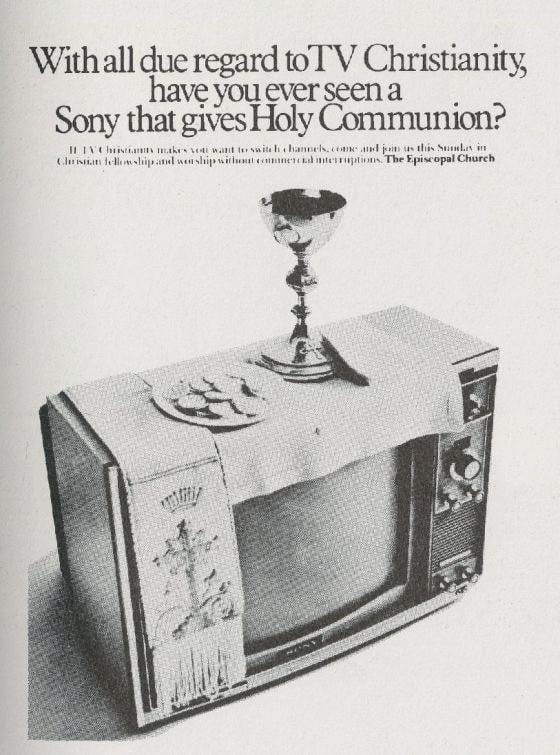
I would argue that wasn’t even the most impactful scandal that Bakker caused. The shift from people going to church to staying home and catching it on a screen instead might be one of the biggest scandals in church life. Many worshipers stopped attending church and stopped supporting it too, sending their offerings to larger, more influential televangelists. This was one more step towards what has now become the disembodied nature of Christian faith.
Christianity, at its core, is an embodied religion. God was born in a human body named Jesus. Jesus was killed, his body was buried, and then it was resurrected. Christians gather regularly to eat bread and drink wine calling it the body and blood of Jesus. The first Christians understood themselves as a body: the body of Christ (Corinthians 12:27). But more and more people are choosing to consume Christian content from screens rather than in the flesh.
Bakker returned to television in 2003 after his release from prison. He cried, talked about his time in prison, and to many appeared to be a humbled penitent man. Not too long after that, though, he started a new show that focused on the end of the world and peddled food that one could use to survive the apocalypse. One could order everything they needed to make it through the Great Tribulation: vitamins, tools, and other survival gear. The show often featured guests that pontificated on conspiracy theories and promoted Christian Nationalism.
His death has prompted mixed reactions. Some of my Pentecostal peers still believe he was humbled and repentant and that he gave up grifting. They either aren’t aware of what he promoted after prison, or they choose to be ignorant of it. For me, I grieve the life and the death of a man who changed the landscape of the faith and not for the better. I grieve how far we have moved from being embodied Christians who do embodied worship. I grieve because my peers are more excited about the pragmatism of mass evangelism than they are doing the hard work of making disciples in their own communities—something no TV or content creator can do.
The shining lights in the life of Jim Bakker were most assuredly his wife Tammy Faye and his son Jay Bakker. Both of them did far more gospel work after Jim’s fall by advocating for the rights of all people regardless of their station in life or sexual orientation, and by being honest and repentant about the glass house they once built and lived in. I pray for Jay today, and for the family, who have lost a loved one. May God have mercy on Jim’s soul, and the souls of all us harmed by the progress he made.