

This Sunday was Trinity Sunday. It always follows Pentecost Sunday in the Christian liturgical calendar. Unlike other Christian holy days, Trinity Sunday does not celebrate an event in the life of the church. It celebrates a doctrine.
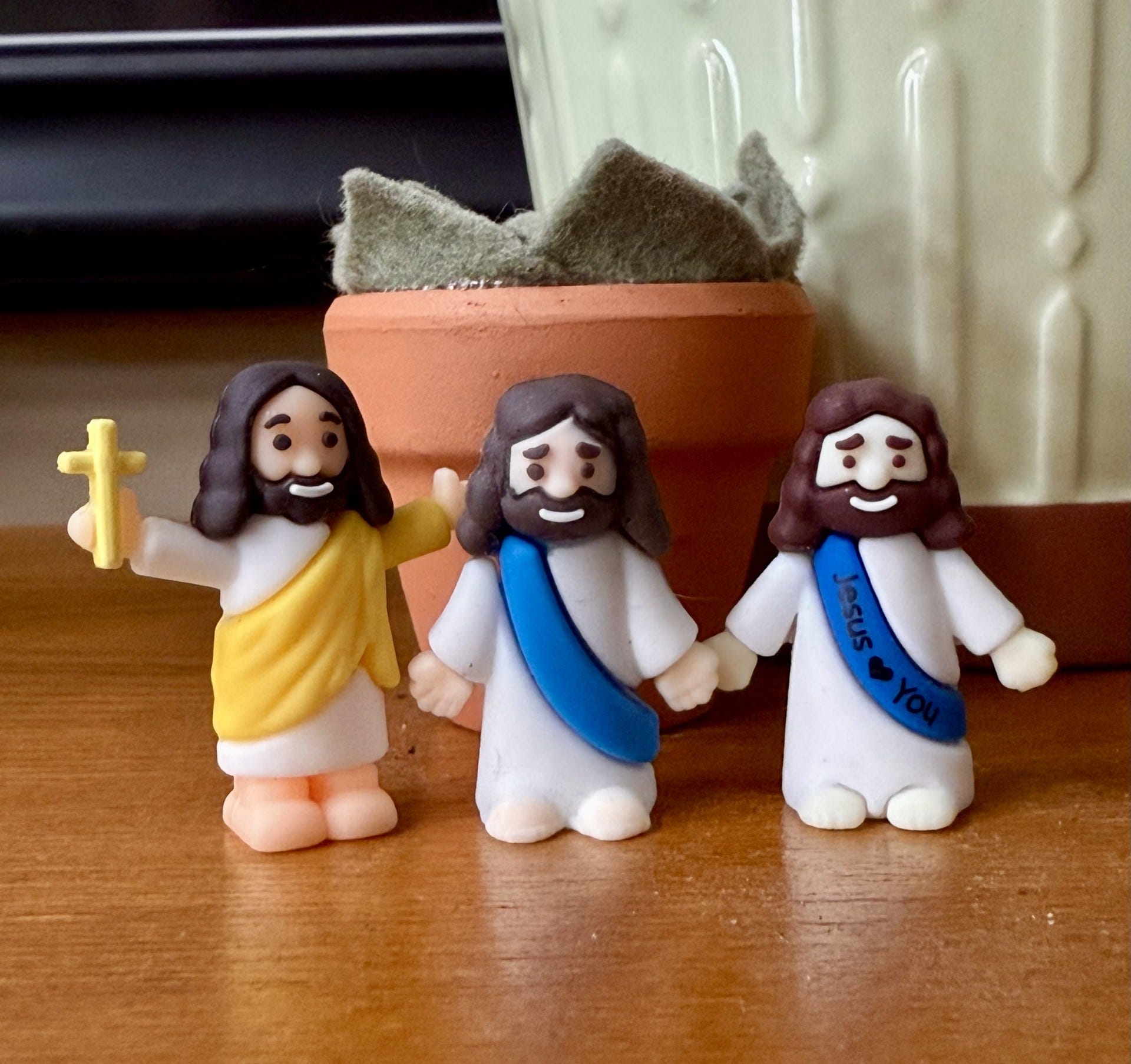
I have always enjoyed celebrating Trinity Sunday, and it was one of my favorite Sundays to preach. The biblical texts for the day were always theologically rich and held so much potential for interpretation. My favorite passage on the Trinity is John 17, where Jesus prays for the unity of his disciples and the church through the centuries, that they may be one as he and the Father are one, God in him and him in God. Unfortunately, it is never prescribed as the gospel reading for Trinity Sunday, but I usually found a way to work it in. That verse not only gives us the evidence we use to help write and defend the doctrine of the Trinity, it tells us about the Trinitarian God’s desire for the church: that they may be in unity as God is in unity. The Trinity is a model for church unity.
I never fully appreciated that until I arrived as a seminary student at Gardner-Webb University and Dr. Steve Harmon taught a class on ecumenism, or Christian unity. Here I was, a Pentecostal preacher at a Baptist school, learning about how to be in unity with Catholics and other churches that seemed so foreign to my experience of the faith. I learned that unity is not uniformity. We may never achieve full communion with one another, but we can identify the gifts each tradition brings to the body of Christ and learn to share them. The locus of unity moves from the appearance of uniformity to an appreciation of diversity.

It was also there at seminary where I heard a preacher deliver a Trinity Sunday sermon that I think about every year when this Sunday comes around. He described his own faith journey as a gradual revelation of the Trinity. He was born into a Presbyterian family and raised hearing about the sovereignty of God the Father. Then he dated a girl who attended a Pentecostal church and went along with her, and there he encountered the Holy Spirit. Then as an adult he became an ordained Baptist minister and came to understand more deeply the Son, salvation, and what it means to be centered on the cross.
Little did I know that was becoming my story. Here, I offer reflections on my own journey of knowing the Triune God from the Holy Spirit to Jesus, from Jesus to the Father.
The Spirit
The Pentecostal church gave me my first and most formative encounter with God, and like most first loves it is complicated to look back on. Nevertheless, the Pentecostals introduced me to Jesus, and taught me a lot about the work of the Holy Spirit.
When I began to surrender my life to God and follow the Holy Spirit, it gave me a high tolerance for ambiguity and mystery, because I felt like I had God as a partner on the journey. It was okay to live and take risks, to go to scary places and do hard things, because God was with me. It was okay to be curious and ask questions.
God was not a million miles away, nor was he too holy for me, nor was he confined to the words on the pages of the Bible. The Spirit gave me hope, a sense of purpose and belonging, and helped me understand the words of Jesus, was somehow Jesus himself, and connected me to the divine in ways I still do not have categories for. I learned how to follow Jesus by being led by the Spirit.
In time, I left the Pentecostal church for reasons I write about elsewhere on this blog.
With one foot out of the Pentecostal church and one foot in, I enrolled at a Baptist seminary. My time at Gardner-Webb University was life-changing. My classmates came from all different backgrounds and all different churches. I learned more from them than I did from the instructors, and that is no small feat.
The Son
The Baptist tradition is insistently Christocentric. Everything comes back to the Son. The cross, the resurrection, the personal relationship with Christ is the organizing center of Christian life in Baptist doctrine. In the Pentecostal church, I had encountered the Spirit with great intensity. At Gardner-Webb I encountered the one the Spirit points to, the one in whom all the traditions find their coherence, the one who prayed in John 17 that they all may be one as he and the Father are one.
“My prayer is not for them alone. I pray also for those who will believe in me through their message, that all of them may be one, Father, just as you are in me and I am in you. May they also be in us so that the world may believe that you have sent me. I have given them the glory that you gave me, that they may be one as we are one— I in them and you in me—so that they may be brought to complete unity. Then the world will know that you sent me and have loved them even as you have loved me.”
Jesus’ Prayer, John 17, NIV
When I arrived at Gardner-Webb, Jesus felt like a Spirit to me. That is what the Pentecostal church had given me — a Jesus who moves, fills, and empowers, a Jesus encountered in the electricity of a worship service.
At seminary, I began to see Jesus in his body. My classmates came from every denomination and every background, and watching God be worshipped and studied across all of those lines did something to my understanding of who Jesus is. The worship and theology classes were open, genuinely open, and we learned from one another in ways that classroom instruction alone could never produce. I learned as much from my classmates as I did from the instructors, and that is no small thing to say.
My Baptist seminary formation felt in some ways like an extension of my Pentecostal upbringing. Baptists also emphasize free worship, the authority of the Bible, and do not have much use for creeds or formal liturgy. But something shifted for me while taking Dr. Harmon’s course on Christian unity. He taught me to see what each tradition contributes to the whole, to look for the gifts rather than the deficiencies, to understand that the Spirit’s work is visible across the full diversity of the church’s expressions. I took that lesson seriously and integrated into my life as fellow student among Christians of all stripes and denominations. I began to find Jesus in his flesh and blood body on earth: the church.
When the Son became flesh, it changed everything about how we understand God. The Son is not only the one the Spirit points to. He is the one who entered the mess of human history, took on a body, and identified himself permanently with humanity. And when he prayed in John 17 that they may be one as he and the Father are one, he was not praying for a spiritual unity divorced from the body. He was praying for the unity of his actual, physical, diverse, disagreeing, complicated body on earth. I found that body at with the Baptists. I saw Jesus incarnate in the church, and it changed the way I follow Him.
The Father
I am Presbyterian now, and Reformed theology is bringing me full circle. Now I am learning more about the Father, the symbol of divine sovereignty. It has not been easy for me to open my mind to this revelation. The sovereignty of God is one of the hardest pills to swallow when you are reconstructing after a season of deconstruction.
Instead of find it restricting, I have found it to be a relief. At the end of the day, the honest answer to most of our deepest theological questions is simply this: only God knows.
It is also helping me appreciate the beauty of God’s love for me. Growing up Pentecostal, the calling was primarily about what you did. You were called to preach, to do vocational ministry, to perform your faith in visible and measurable ways. In Reformed theology I am learning that even my salvation is a call. God found me before I found him. I am not in church trying to find God. I am in church because God found me.
That shift has given me a confidence in my relationship with God and his church that I did not have before. The Father is the one who holds the whole story, whose sovereignty means that even the seasons when my life fell apart were inside his providence, whose covenant stretches back before I was born and forward beyond anything I can see. That is not a small God. That is a God large enough to hold everything I have experienced and everything I still do not understand. Finding my way into that reality has felt, more than anything else, like coming home.
Why the Trinity Is Still the Answer
There are Christians today, many of them deconstructed post-evangelicals, who are exploring polytheistic frameworks to make sense of their experience of the divine. Some are drawn to Divine Council theology, associated with scholars like Michael Heiser, with its vision of a heavenly court of divine beings. Others simply find that a bare monotheism feels too thin to account for the richness of genuine encounter with God, or they feel it makes it more difficult to make sense of God’s violence actions as reported in the Old Testament. These are not new concerns. Marcion tried to resolve this in the 2nd century by claiming Jesus was not the son of the Old Testament God. Nor are these random departures. They are symptoms of a real hunger for a God who is relational, dynamic, loving, and personally present.
The ancient church wrestled for centuries with exactly these questions, and what emerged was not a philosophical compromise. It was a revelation. One God, undivided, in three persons. A divine community, eternally relational, eternally giving and receiving, eternally other-oriented. The Trinity tells us that at the heart of ultimate reality is not a solitary sovereign but a community of love. God is not alone and has never been alone. The relationality we experience as the deepest feature of human life is a reflection of the nature of God himself.
This is something more ancient and more satisfying than a divine council, and it took the whole church, across centuries and traditions and arguments and councils, to find the words for it. It is not polytheism, where each God is distinct and separate and sometimes in conflict. It is three in one, one in three, undivided, a divine community that is also a model for human community. When the church gets it right, when it lives as a community that holds unity and diversity together without collapsing either, it is reflecting something true about the nature of God.
Language Is Inadequate But Not Useless
The church has always said the Trinity can only be fully understood through revelation, and that even then words fall short. Every analogy breaks down. The three-leaf clover, the three states of water, the three roles of a single person — all of them capture something and all of them distort something. The Trinity is finally a mystery, and mystery is a reality to be inhabited rather than a problem to be solved.
Language is part of how revelation works. The Spirit uses words, inadequate as they are, to point toward what words cannot fully contain. That is what preaching is. That is what theology is. That is what this piece is. An attempt to give the best shape we can to something that exceeds our capacity to describe it.
I grew up Pentecostal and encountered the Spirit who cannot help but tell the truth. I studied at a Baptist seminary and encountered the Son in whom all the traditions find their unity. I am becoming Presbyterian and encountering the Father whose sovereignty is large enough to hold everything I do not understand. The doctrine that makes sense of all three encounters, that insists they are one God and that their oneness is the ground of everything else, is the Trinity.
It is mysterious. It is mystical. And if I am honest, it is also just cool! There is nothing quite like it in any other faith tradition.
Glory be to the Father,
and to the Son, and to the Holy Ghost;
as it was in the beginning,
is now, and ever shall be,
world without end. Amen, amen.
https://allendaves.substack.com/p/children-of-a-lesser-god?utm_source=share&utm_medium=android&r=1xhldx